When the Saturn–Neptune Conjunction Speaks to Us… of Stones and Waters
The Epstein affair and the fall of the powerful show us the Saturn–Neptune conjunction at work, in its most symbolic expression. Other, lighter examples also reveal it in an almost literal form. On January 29 and 30 (with the conjunction at an orb of 1°34), lectures were held in Brittany about the discovery of walls more than 7,000 years old, submerged off the coast of the island of Sein — a discovery unique in France at such depths (7 to 9 meters). Investigations revealed alignments of large granite blocks, some reaching nearly two meters in height. Their arrangement clearly indicates human construction, the leading hypothesis being that they were stone fish weirs. This discovery quickly brought back to the surface the famous Breton legend of the sunken city of Ys, which tells of a prosperous city swallowed by the sea.
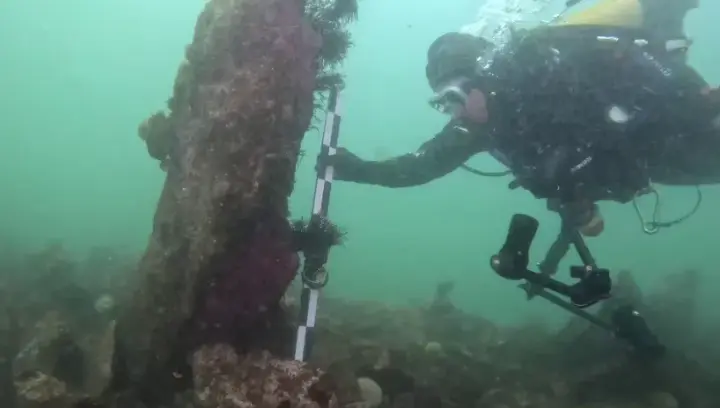
This discovery, widely covered in the media at the very end of 2025, when the Saturn–Neptune conjunction was already active (with an orb of about 4°), made me want to explore the link between these two planets and other cities submerged beneath the waters.
I then learned that archaeologist Kathleen Martinez believes she may have discovered Cleopatra’s tomb. On September 18 (with the conjunction at an orb of 2°09), the Egyptian Ministry of Tourism and Antiquities announced the discovery of a sunken port in the depths of the Mediterranean Sea. After years of investigation, Martinez realized that the queen’s final resting place should be sought not in Alexandria, but in a little-known nearby temple called Taposiris Magna. This quest led her to uncover this submerged port dating back to Cleopatra’s time. Taposiris Magna was therefore not only an important religious center, but also a maritime trading hub, far more extensive than previously imagined. “That makes the temple really important,” Martínez says, adding that it “had all the conditions to be chosen as the burial place of Cleopatra with Mark Antony.” She believes that the discovery of the queen’s tomb should follow soon.
Marine archaeologist Robert Ballard, who discovered the wreck of the Titanic, was part of this adventure, and still in 2025, during the month of July (with an orb of 0°13), he also led an expedition to Ironbottom Sound, off the Solomon Islands, to explore World War II shipwrecks. Some of these vessels had not been seen since the 1940s.
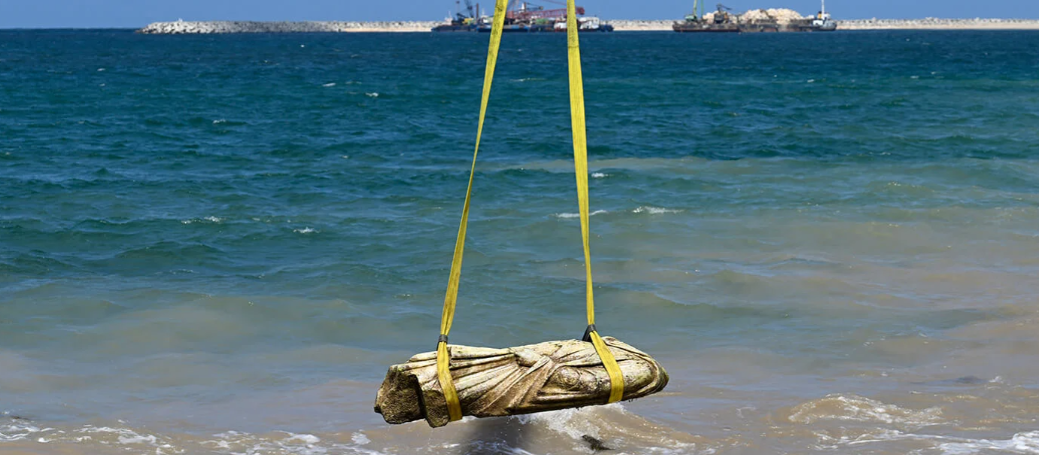
To return to Alexandria — the city where Cleopatra’s tomb was initially thought to be located — the remains of a 2,000-year-old sunken city have recently been discovered there. On Thursday, August 21, 2025 (with an orb of 0°53), the Egyptian government unveiled the remains of this city, discovered in Abu Qir Bay, off the coast of Alexandria. Several statues were carefully lifted out of the water using cranes and slings, to the applause of the divers who had taken part in their recovery.
Credits : © Khaled Desouki / AFP
It is interesting to recall that the Centre d’Études Alexandrines, created by a French archaeologist to rediscover the famous lost Wonder of the Ancient World — the Lighthouse of Alexandria — was founded during the previous Saturn–Neptune conjunction, in 1990. The Helike Project, for its part, was also launched during the previous conjunction (1988), with the aim of locating the sunken Greek city. Helike had been a prosperous city and the seat of the Achaean League. However, in 373 BC, within the space of just a few hours, it was swallowed by the sea following a powerful earthquake, disappearing along with its temples, houses, and inhabitants. Subsequent investigations showed that the site had been submerged in a lagoon and that sedimentation later caused the ground level to rise again, allowing the land to re-emerge. Helike was finally rediscovered in 2001 (during a Saturn–Neptune trine), buried within this former lagoon, near the present-day village of Rizomylos.
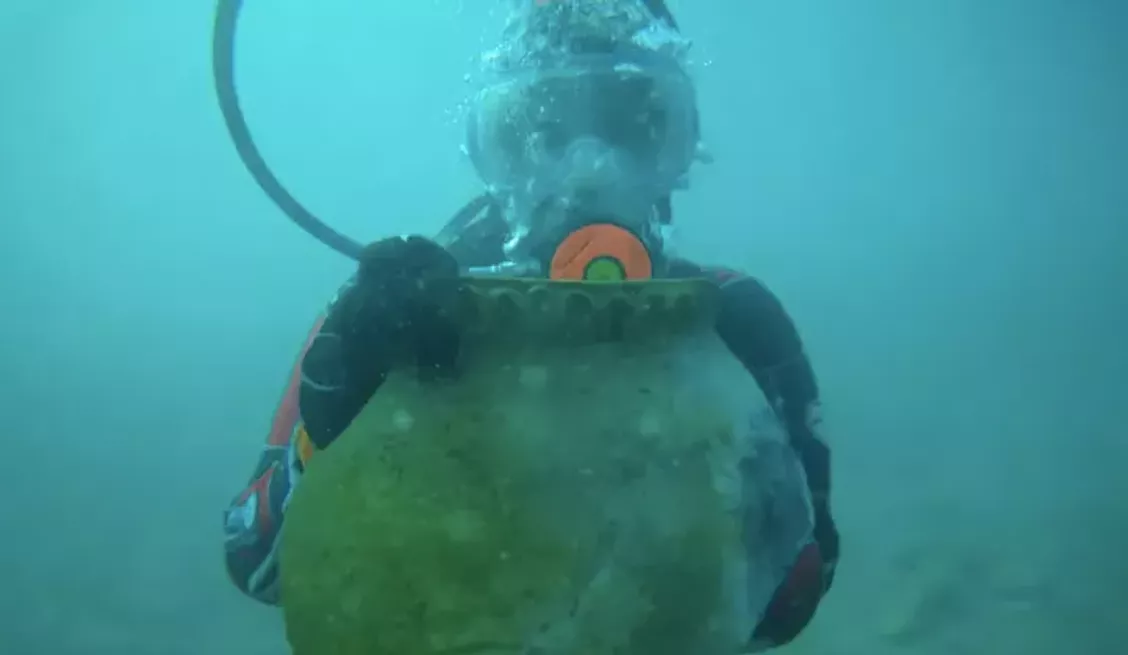
Still in 2025, what could be the Atlantis of Asia Minor was reportedly discovered. An ancient city was found in a lake in Kyrgyzstan, a former Soviet republic located between Kazakhstan and China. The announcement was made in October (with an orb of 3°26): the sunken city lies beneath the waters of Issyk-Kul, a lake situated at an altitude of 1,600 meters. How did such a city end up submerged? Like Helike, it is believed to have sunk following an earthquake that caused the city to be engulfed by the lake’s waters. The catastrophe that destroyed it is said to be comparable in scale to that of Pompeii.
Credits : Russia Sciences Academy
The Saturn–Neptune conjunction thus brings our past back to the surface, in its most concrete form (its stones) — after it had been submerged and hidden beneath the waters by Neptune (Poseidon, also known as the Earth-Shaker, being an archetype associated not only with rising waters but also with earthquakes that trigger tsunamis or collapses into the sea). On a global level, tangible proof of what had been hidden is being revealed to us (Epstein). Donald Trump even went so far as to announce, on the very day of the exact conjunction, that he would disclose evidence of the existence of UFOs. On a more personal level, concrete elements of our own past may rise to the surface — forgotten facts, or truths that were deliberately concealed from us, by others or even through our own repressive mechanisms. Truths are seeking to come to light. Dreams (a plunge into the Neptunian ocean) are also one of the ways through which we can access these lost truths.