In recent times, the Saturn–Neptune conjunction—already active in 2025, with a first exact alignment in Pisces in April, and set to be exact again in February 2026, this time in Aries—has not shown us its best side.
Themes of the unraveling (Neptune) of established structures and powers (Saturn)—or even of the dissolution of morality or ethics—come readily to mind when we look at current events, sometimes with dismay.
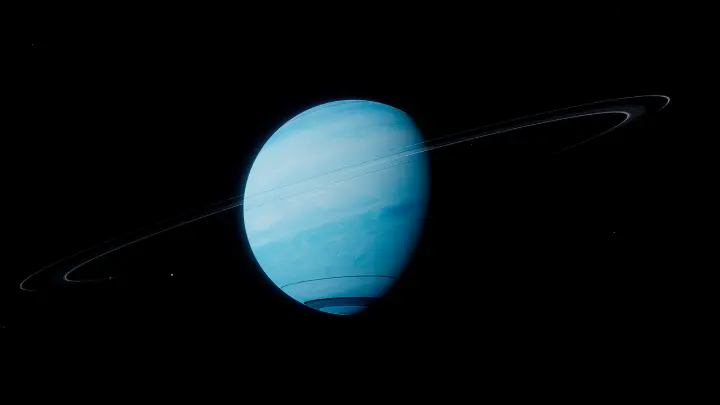
I would like to offer here a complementary—and more optimistic—perspective on what this planetary dynamic might bring us. Let us first note that Neptune was discovered at the time of an exact conjunction with Saturn, in the sign of Aquarius. This conjunction aptly symbolizes the planet’s discovery: Saturn is the last planet visible to the naked eye and therefore represents the limit of what is directly accessible to us. Neptune then entered our Saturnian world, becoming visible through an optical instrument. But Saturn also marks the moment when Neptunian values can be inscribed into Saturnian law.
Moreover, the years preceding and following Neptune’s discovery were marked by the Romantic movement on the one hand, and by the emergence of fundamental laws concerning animal protection on the other. One of the defining features of Romanticism was its attempt to reconnect with nature, echoing the words of Dionysus reproaching Thebes for having cut itself off from the natural world. It is also worth remembering that Neptune was regarded as a protective deity of horses.

If we examine closely the dates of the major milestones that have shaped the development of animal protection and the recognition of animals as sentient beings, significant aspects involving Neptune—often including Saturn—stand out clearly.
Thus, the first major European—and arguably global—advance for animal rights was the Martin’s Act, adopted in the United Kingdom in June 1822, at the time of an exact Saturn–Neptune trine in Earth signs. This law is foundational, as it marks the first time the State recognized that causing suffering to an animal is legally punishable and acknowledged that an animal is no longer merely property, but a being whose suffering must be taken into account. This legislation directly led to the founding of the SPCA (later the RSPCA) in June 1824, at a time when Neptune was exactly conjunct the North Node in Capricorn.
France and the United States followed a few decades later. On 2 April 1845, the Société protectrice des animaux (SPA) was founded in France, at a time when Neptune was square the nodal axis (with a 1°30 orb). France then adopted the Grammont Law in July 1850, which penalized public acts of cruelty toward animals. At that time, Neptune was square Chiron (1° orb).
.  Creation of the French S.P.A.
In April 1866, the ASPCA (American Society for the Prevention of Cruelty to Animals) was founded in New York, at a time of an exact quincunx between Saturn and Neptune, and with Neptune conjunct the South Node in Aries—the very sign it will enter again next February.
We then come to 1911, when the second major law in the entire history of animal protection was adopted—once again in the United Kingdom. In April, the Protection of Animals Act was passed, extending protection to all domestic animals, not just livestock. This law introduced the notion of cruelty, detailed criminal prosecutions, and provided for the intervention of public authorities. It became a reference model for a great many twentieth-century legislations, and even today many legal definitions still derive from this text. It was adopted at a time of a sextile between Saturn in Taurus and Neptune in Cancer, with a 2° orb. It would later inspire the State of Texas, which adopted the first Humane Slaughter Act in January 1913—subsequently leading to federal legislation—once again under a Saturn–Neptune sextile, still in Taurus and Cancer, and again with a 2° orb.
In December 1946, the cow became the first animal to receive specific protection under constitutional law, in the Indian Constitution. At that time, Neptune was trine the North Node and sextile Saturn and Pluto.
In 1957, the Treaty of Rome, which founded the European Union, recognized animals only as agricultural products. However, in 1958 and 1959, two major developments are worth noting, at the time of an exact sextile between Neptune in Scorpio and Pluto in Virgo: the United States adopted the Humane Slaughter Act at the federal level, a law requiring the limitation of suffering during slaughter (for farm animals). France, for its part, recognized the concept of animal suffering through the Michelet Decree.
It was in August 1966 that the third major law in the history of animal protection was adopted: the Animal Welfare Act in the United States, at a time when Neptune in Scorpio was exactly conjunct the South Node. This legislation placed animal welfare at the heart of modern public policy and went on to inspire many other countries. It introduced a national framework governing animal experimentation, transport, and the use of animals for commercial or scientific purposes.
In December 1976, India added to its Constitution the “fundamental duty” of citizens to protect nature and to show compassion toward living creatures. At that time, Neptune and Saturn were in trine. On 5 October 1988, the Brazilian Constitution prohibited public authorities from subjecting animals to acts of cruelty. Neptune was then in exact square to Chiron.
Finally, the most recent major milestone is the European Treaty of Lisbon, which entered into force on 1 December 2009—at the time of a Neptune–Chiron conjunction—recognizing animals as sentient beings. However, it was concretely implemented in January 2012 with the publication of the European Union Strategy for the Protection and Welfare of Animals. At that time, Saturn and Neptune were in exact trine in Air signs. This treaty now serves as an international reference in legal debates.
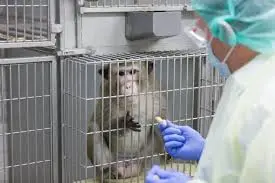
Several advances in animal rights were announced in 2025. In June, Italy promulgated the Legge Brambilla, strengthening protections against animal cruelty and amending the Penal Code. At that time, Saturn and Neptune were already conjunct in Aries (within a 1° orb). Meanwhile, as the European Union announced the launch of a major consultation on the revision of EU animal welfare legislation, two countries made noteworthy statements on 2 December 2025. Australia announced legislation to end the export of live sheep by sea as of 1 May 2028, while Poland saw the presidential signing of the ban on fur farming. Neptune was then in exact sextile to Uranus. In the United States, PETA welcomed the signal sent by Health Secretary Kennedy regarding the cessation of the use of monkeys in animal experimentation, and on 1 January 2026 South Korea announced the official end of the farming and possession of bears for bile extraction—at a time when Saturn and Neptune had resumed direct motion and their conjunction stood at a 3° orb.

Can we then hope that 2026 will bring an acceleration of global awareness regarding the moral importance of animal welfare? Can we hope that their suffering will become utterly intolerable to us? Aries is known for its capacity to act, to move forward, to initiate. Neptune, as we have seen, plays a central role in animal protection. Saturn in Aries speaks of uprightness in action—of taking responsibility for the consequences of our actions or desires, and of aligning our will and our laws with our moral values. Let us therefore hope, for the sake of humanity (and of animals!), that this Saturn–Neptune conjunction in Aries will also reveal its very best expression.