A Yod and a Mission: Maria Montessori, or Chiron Embodied
In Maria Montessori’s natal chart, the Sun is at 7°28 Virgo, the Moon is in sextile at 4°33 Scorpio, and Chiron forms a quincunx to both of these planets at 6°39 Aries. This configuration is therefore a Yod. The term “Yod” comes from the name of the smallest letter of the Hebrew alphabet, symbolizing humility but also the divine spark—since, in Jewish mysticism, the yod represents the point from which creation emerges. We thus find the creative potential inherent in this natal configuration.
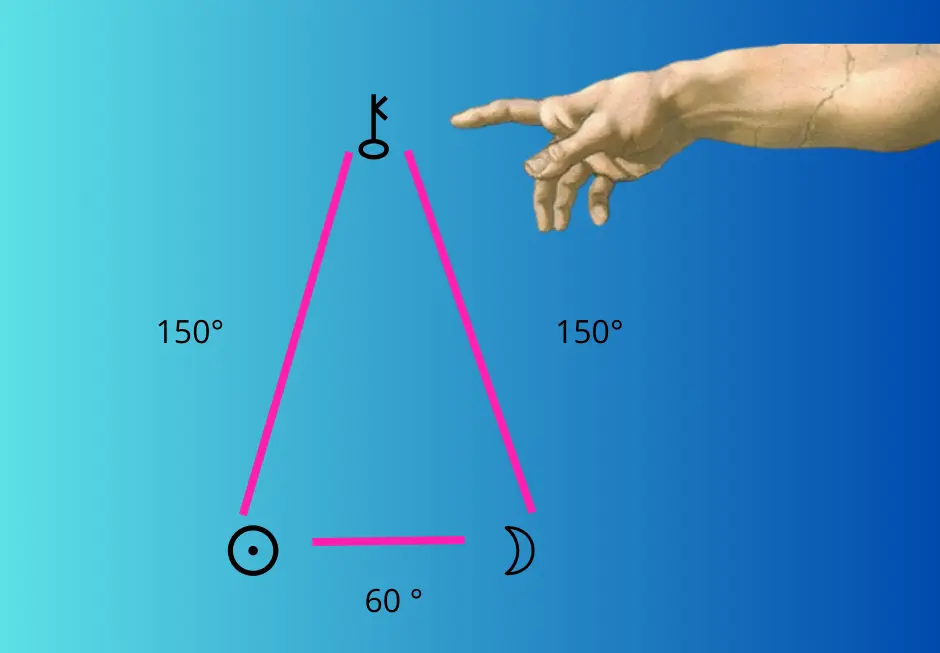 A yod, or "Finger of God"
Yods were not taken into account in traditional astrology but were introduced in the mid-20th century. They are therefore seen as the “Finger of God,” as the configuration points toward the third planet, which is in quincunx to the other two.
The planet at the apex is thought to act as a kind of portal for the individual—a challenge to be met in order to access, depending on the perspective, an expanded state of consciousness, one’s life mission, or, in esoteric astrology, the will of God. The two planets at the base represent the resources available to achieve this. The Yod is a powerful engine of individual growth, compelling the individual to confront their destiny and fulfill their mission, while simultaneously being a source of ongoing tension. It is a call to embark on a quest, to integrate the apex planet through a series of crises and transformations.
This is the theory, but when studying Maria Montessori’s chart, one can only observe that the apex planet, Chiron, did indeed symbolize her life mission. Maria was born to a mother who, by the standards of Italy at the time, could be considered educated, as she was able to write her own name. Recognizing her daughter’s abilities very early on, she encouraged her to pursue an education. Maria’s father opposed this, believing that a girl from their bourgeois background was meant to marry. Moreover, Maria wanted to study medicine, which was considered even worse, as she was expected to see naked bodies!

Maria had to proceed without her father’s approval and work to pay for her studies, yet she succeeded in becoming the third woman in Italy to earn a medical degree. Chiron, too, was a physician (his name shares the same root as *surgery* and *chiropractic*). Montessori then turned toward psychiatry and worked at the psychiatric clinic of the University of Rome, in collaboration with Giuseppe Montesano. What she witnessed there deeply shocked her: children with intellectual disabilities were housed together with adults and received no specific care or treatment. She therefore decided to devote her early years as a physician to improving their condition. Here, the parallel with Chiron becomes striking: Chiron—because of his difference, his deformity, his centaur’s body—was a source of shame to his mother, just as these unfortunate children, labeled “idiots” at the time, brought shame upon their parents and were abandoned in institutions.
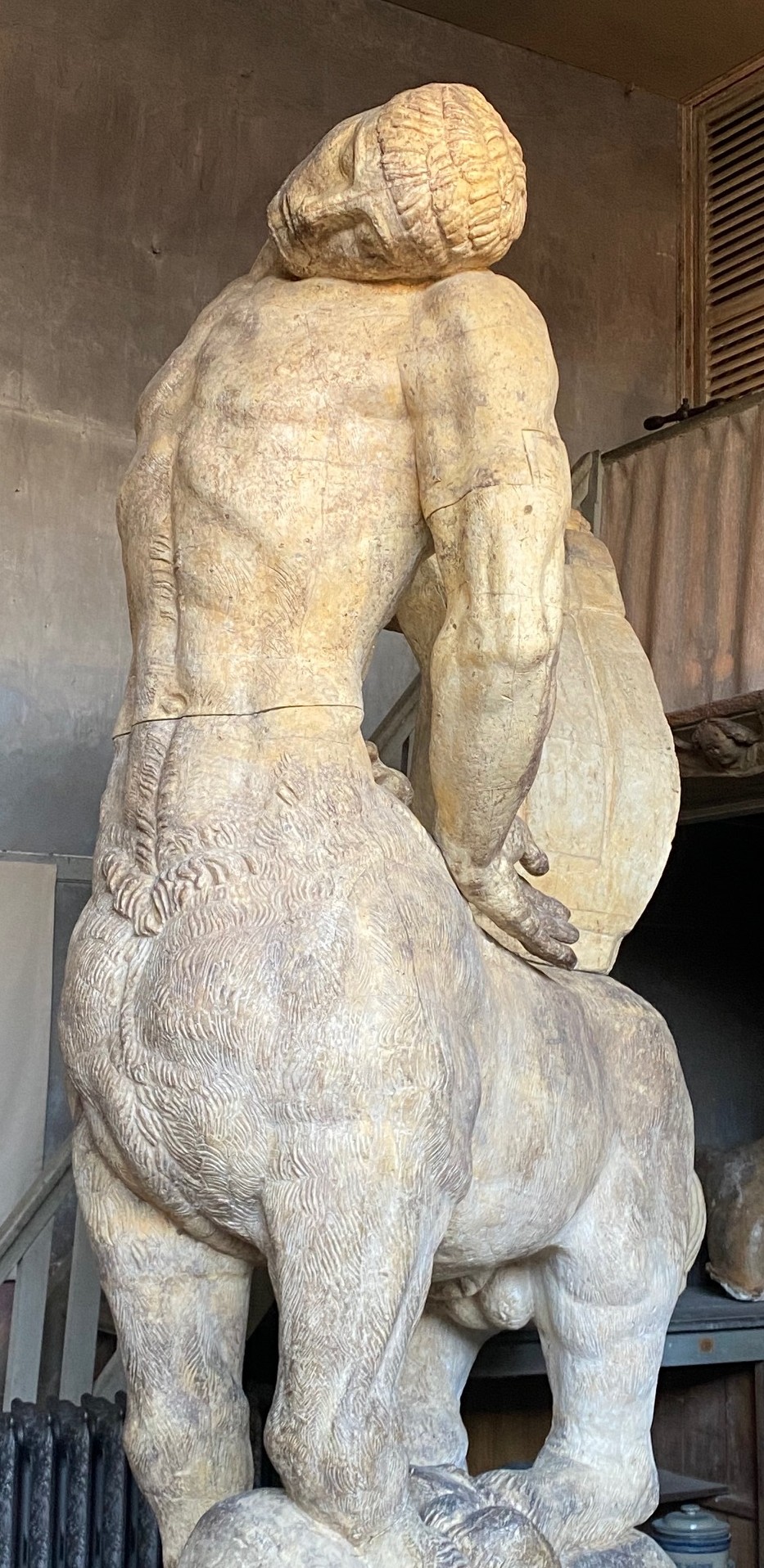 Chiron, Bourdelle museum, Paris
Maria obtained from the hospital director the creation of a separate ward, which would be considered one of the first child psychiatry units in Italy. Observing that the children engaged in no activities at all, she provided them with games, as hands-on manipulation seemed to her to be an essential element in cognitive development. She also began to develop a whole range of materials to help them learn to read and write. Her Virgo Sun clearly shows her talent here, combining reflection with practical application, analyzing problems and finding solutions. Montessori achieved very significant successes and quickly realized that what had worked with children with intellectual disabilities would necessarily work with so-called “normal” children as well.
THE ORTHOPHRENIC SCHOOL, 1899
Her work at the clinic brought her into direct contact with scientific circles in the United Kingdom and France. It was in this context that she became interested in early 19th-century French scientific literature dealing with cases of feral children—children raised by animals and discovered in remote regions during the 18th century. Here again, we find a literal reference to the myth of Chiron: abandoned, Chiron found himself alone in the forest, and like a wild animal he had to hunt and eat raw animals (we are even told of their entrails) in order to survive.
 The Education of Achilles, Bénigne Gagneraux 1785
In 1899, she became the first director of Rome’s orthophrenic school, which was responsible for adolescents with intellectual disabilities. As her interests shifted toward education, she decided to renew her cultural foundations by earning a degree in philosophy. Thus, Maria moved from Chiron the physician to Chiron the teacher, continuing to work with children, just as the centaur cared for Achilles, Jason, or Heracles, for example. She discovered the work of Jean Itard on deaf-mute children and that of Édouard Séguin on children with intellectual disabilities. Her observations and research led her to the conclusion that an educational method was more beneficial for children with intellectual disabilities than a medical or chemical solution. She adopted the materials designed for children with disabilities—most notably the sandpaper letters—and developed her first Montessori materials. The success of these children with intellectual disabilities in national examinations, on a par with other Italian children, demonstrated the effectiveness of her approach. This experience convinced her that every child has potential, and that it is enough to give them what they truly need in order for that potential to emerge.
LA CASA DEI BAMBINI 1907
The opening of the first "Casa dei Bambini" (Children’s House) in the San Lorenzo district of Rome would become, for her, an experience that definitively laid the foundations of her pedagogy. She was entrusted with the task of removing the children of this poor Roman neighborhood from the streets. Children aged three to six were left to their own devices: “Poor abandoned children who had grown up without any mental stimulation, downtrodden and neglected,” as she would later say. What began as basic objectives of order and hygiene evolved into a fully developed pedagogy. She thus focused her efforts on the learning environment, developing furniture scaled to the children’s size and materials specifically designed for them—sensory and tactile materials, in particular self-correcting ones, allowing the child not to rely constantly on an adult. She also based her approach on the free choice of activity. These children succeeded in learning to read and write, and new Children’s Houses and schools sprang up throughout Rome. Observers arrived from all over the world.
THE CREATION OF THE INTERNATIONAL MONTESSORI ASSOCIATION (1929)
Subsequently, Maria traveled extensively to train teachers and give lectures in order to present her theory of child development. Here again, she embodied Chiron the teacher—this time as a transmitter of knowledge to her peers. Throughout her life, Maria Montessori continued her research into all stages of childhood. After focusing on the child from ages three to six, then from six to twelve, she turned her attention to adolescence, and later to the very young child, from birth to three years old. Settled in the Netherlands, Maria Montessori died there in 1952, at the age of 81.
 Example of Montessori Materials
CONCLUSION ON THE YOD IN MONTESSORI’S NATAL CHART
In Maria Montessori’s chart, the two luminaries are in sextile, and we can indeed see how Virgo’s love of work, precision, and practicality combined with the depth and empathy of her Scorpio Moon to develop and refine her method. But the ultimate purpose, the meaning of this association, is clearly indicated by the planet at the apex: Chiron—the one who teaches and heals, who welcomes and transmits. Chiron is in Aries, and Maria Montessori is often described as the one who “taught children to do things by themselves.” She herself said: “Any unnecessary help is an obstacle to the child’s development.” The two quincunxes clearly show that this did not occur without hardship for Maria. On the Sun’s side, the meaning of her existence could not be personal, centered on her own individual fulfillment, but had to pass through what she offered to the collective. On the Moon’s side, she had to give up her son at birth in order not to ruin her career and lose any possibility of helping the children in her care.
The Yod present in her natal chart clearly shows that this configuration may involve an element of sacrifice—or at least the necessity of finding a different, more creative way of living out the two planets that are in quincunx and that support the third. The planet at the apex, for its part, symbolizes a drive, a mission, a meaningful dynamic that contributes to making an individual’s life unique.